Merfolk
As a merfolk, you share these racial traits with others of your kind.Ability Score Increase. Your Intelligence score increases by 2.
Age. Merfolk grow and age at approximately half the rate of a normal human, attaining adulthood in 30 to 35 years. They live to be around 160.
Alignment. Merfolk tend to be neutral on the cosmic war between chaos and law, although exceptions exist, especially for very tight communities where lar prevails, or banished or orphan indivudals who can tend more toward chaos. Their side on the good and evil axis depends a lot on their personal experience, tending toward evil if they experienced or witnessed evil acts, or towards good if vice-versa.
Size. Merfolk are more or less the same height as humans, but tend to be lighter in build than the average human.
Speed. Your base land speed is 30 feet. You also have a swimming speed of 35 feet.
Aquatic. As a merfolk you can breathe underwater, and being underwater imposes no penalty on your attack roles or ability checks.
Languages. You can speak and read Merfolk and Common.
Reflexive Twitch. In place of an Opportunity Attack or when surprised by or surprising enemies, move half your speed without provoking Opportunity Attacks and without expending movement or actions.
Curious Researcher. Choose a feat that grants a bonus to an ability score. You gain its bnefits, except for the bonus to the ability score.
If feats are not in use in your game, choose two different bonuses among the following: proficiency in one skill, one weapon, one saving throw, one tool, or learn a language.
Subrace. Merfolk exist in many planes, and in each plane they develop substantial differences and adaptions

Zendikar
Zendikar is a plane of stronger and more pervasive magical forces, where the land itself changes constantly under the geo-magical phenomenon known as the "Roil". Zendikar merfolk have attuned so well to this that they know how to be nexuses for the Roil, even in planes where the Roil doesn't usually manifest: when any spell disturbs the natural order, you can "ride" the magical currents that get amplified by your presence and take advantage as the laws of physics change around you.Ability Scores. Your Wisdom score increases by 1.
Roil Nexus. When casting a 1st level or higher spell, or as a Reaction when a 1st level or higher spell is casted within 10 feet of you, choose one of the following effects:
- One or two creatures within 10 feet of you are pushed up to their speed in any direction (Strength saving throw negates, saving throw DC is 8 + your Proficiency Bonus + your Wisdom modifier)
- You and a willing target within 10 feet of you gain a fly speed equal to the respective base land speed until the start of your next turn.
- Choose an area within 10 feet of you up to 10 feet per side to become heavily obscured or 4 areas of 5 feet per side to become lightly obscured, until the start of your next turn.
Ravnica
In Ravnica, Merfolk have lived in isolation under the surface of the city for centuries. When they emerged, they found themselves at home in a recently battered Simic guild and eventually took control of it and brought it back to a prominent position.The guild's take on evolution matches perfectly your own fast adaption to new environments.
Ability Scores. An ability score of your choice other than Intelligence increases by 1.
Fast Evolution. If after two consecutive long rests you exhaust your Hit Dice by healing, you gain an additional Hit Die to spend in healing until the next long rest. Alternatively, if after two consecutive long rests you exhaust your daily spell slots, you gain an additional daily spell slot of the highest level you can cast until the next long rest. These bonuses can't happen at the same time and are not cumulative. If both conditions apply, the Hit Die benefit applies.
______________________________________
Original "design notes" of my 4e Zendikar adaption (here) - annotations in italic.
I envisioned two principal themes while exploring Zendikar's Merfolk [cards]: exploration/scouting and knowledge.
They are described as solitary in the sense that they enjoy researching in solitude, but most of their abilities benefit their allies as a group. They have a leader streak mechanically, without actually being charismatic. They lead with their knowledge.

There were many powers that fitted as a racial power for them, so I decided to make a single power with many uses depending on the merfolk's power source. This encourages hybrids and/or multiclassing, and makes the Bard an attractive class for the merfolk (which is thematically fitting IMO), even if Charisma is not given a bonus. - I simplified this by just letting them choose the effect. The concept of power source could still be used in Next, but the caster classes are too few for now, and even if I considered making the effect tied to spell school, it would have made the effect more "arcane", when it's intended to be more a "ride the currents of magic" thing.
Their other signature ability is knowing an extra encounter or at-will power of their level but needing to swap it with another one in order to use it. It's like they all have a mini spellbook, which I think is fitting because they're listed as wizards more often than any other class, and this power swapping during resting also sounds as something a solitary explorer/researcher could do, to prepare him or herself to the next challenge in advance. - This was of course re-adapted into the toned-down feat.
The explorer feature can be powerful and it can be extended to allies via feat: extra move action during surprise rounds. Note that it can be combined with the racial power, which is a minor action, and can thus be used by burning a move action if need arises. - No more racial feats, and no combination of racial power with the Reflexive Twitch. After all, it's not intended to be an at-will racial power, but a feature that can be linked to a spell, it's more passive.
Last thing, maybe the most overpowered, the racial power doesn't scale with level in quantity of bonus, instead gaining more uses per encouneter. Two at paragon and three at Epic. I thought that maintaining the effects low, it could have been a good way to represent the resourcefulness of the Merfolk. - Of course, I didn't make the "racial power" scale, because it's already quite powerful for Next standards.
P.S.: The Ravnica subrace is quite uninspired I guess, but I think it was uninspired in the setting as well. They just needed an iconic Blue race to put in Ravnica, but they didn't expand on them enough, so I just wanted to make them flexible and with a take on the theme of evolution, typical of their Simic Combine guild.
________________________________
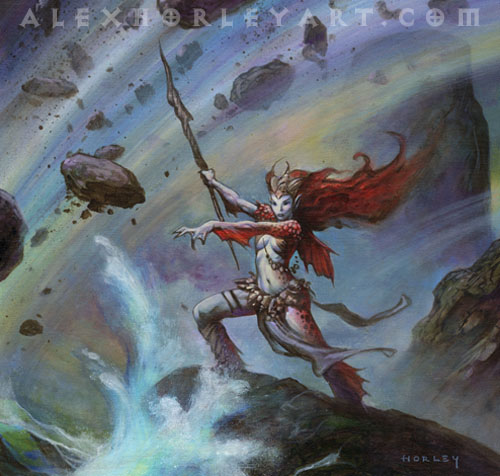
And that's all! Above you see my favorite Merfolk character, Cylonea, whose card-inspiration, Caller of Gales, is also the inspiration for the flying-giving power of my Merfolk race write-up (she's a very basic Merfolk but she can give flight to any creature, so I figured it was quite a basic thing for them in Zendikar!).
She can't be converted right now, because there's really nothing like the 4e version of the Shaman (and a World Spirit Shaman at that!) and the Artificer.
I could eventually try to make the spirit companion a matter of Feat, but then I wouldn't really know on top of which class to put it to represent her. Druid would be ok if it wasn't for the unavoidable Wild Shape which really doesn't suit her. I just hope that between the Warlock and the Sorcerer, something will come up in Next to represent her in a nice way!